Introduction
Contextualizing Relational Metacognition, Regenerative Design, and Systems Thinking
As we navigate complex challenges in education, organizational development, and sustainable innovation, frameworks like relational metacognition, regenerative design, and systems thinking offer distinct yet complementary perspectives. It can be helpful to read first this article “Beyond Connections: Relational Cognition and Regenerative Design for Adaptive Systems”, where I go deeper into the different frameworks.
This article synthesizes these perspectives, integrating insights from Leen Gorissen, Jesús Martín González, Curtis Ogden, Miguel Pantaleon, Jan de Visch, and other thought leaders. It explores how these frameworks challenge static thinking, empower co-design, and amplify relational and systemic potential.
Theoretical Foundations: Relational Metacognition, Regenerative Design, and Systems Thinking
Relational Metacognition
Relational metacognition foregrounds the dynamic interplay between individuals and the systems they inhabit. Unlike systems thinking, which often reduces relationships to transactional connections in a network, relational metacognition emphasizes commitments — enduring, meaningful relationships that shape cognition, and interaction, …
This framework also acknowledges relationships between humans, animals, objects, and contexts, recognizing their interdependence. Relationships are seen not as fixed nodes but as evolving commitments that honor the temporal and contextual dimensions of systems.
Relational Metacognition (RM) offers a unique approach to complex systems and processes by focusing on how individuals and groups think about thinking in the context of relationships. This framework views cognition not as an isolated activity, but as deeply interconnected with and influenced by the relationships within a system. It is a reflective practice that encourages awareness of cognitive processes at multiple levels — individual, interpersonal, and collective — while recognizing that all these layers are interwoven in dynamic, complex systems.
Regenerative Design
Regenerative practices honor the interconnectedness of past, present, and future, fostering relationships and conditions that enable systems to thrive. This perspective aligns with relational metacognition by amplifying systemic and individual creativity while challenging rigid, predetermined outcomes.
Systems Thinking
While systems thinking provides a valuable lens for mapping interconnections and feedback loops, it often retains a transactional orientation. Human-centered design in systems thinking can sometimes view actors as isolated components, emphasizing functionality over relational depth.
By integrating insights from relational metacognition and /or regenerative design, systems thinking can evolve to include deeper relational and ecological principles, fostering sustainable and adaptive systems.
Key Thinkers and Their Contributions
Jesús Martín González: Societal Behavior and Ethical Pathways
González explores feedback loops in societal systems to understand adaptive behavior. His MAMA framework integrates:
- Moral Dimensions: Rooting systems in ethical and universal needs.
- Societal Networks: Broad, historical views of interconnectivity.
Relational metacognition differs by emphasizing fluidity and the iterative co-creation of meaning in relationships, rather than fixed ethical pathways.
González’s exploration of system dynamics and feedback loops offers tools for understanding behavioral patterns within societies. As an anthropologist, he examines how cultural commitments and societal structures influence adaptive and sustainable behaviors. While relational metacognition emphasizes interpersonal relationships and the co-shaping of thought through connection, González’s perspective centers on how these dynamics play out across societies, often through historical, cultural, and systemic lenses.
Jesus Martín’s foundational approach is to understand human systems and the pursuit of a meaningful life. Martín’s framework emphasizes a journey deeply rooted in moral and ethical dimensions, drawing from holistic sustainability models like MAMA (Mallmann-Martín). His approach prioritizes fundamental human needs — such as transcendence and maturity — as central to achieving planetary wellbeing. This vision reflects a commitment to values-driven, context-sensitive pathways, advocating for a “science with conscience” that aligns human actions with the wellbeing of the Earth. Both perspectives offer valuable insights, yet they operate from distinct paradigms — one rooted in normative principles for achieving wellbeing, and the other in the adaptive navigation of relational systems.
Curtis Ogden: Champion of Collaborative Energy Systems Practice
Ogden focuses on collective intelligence through trust-building and emergent design, emphasizing:
- Relational Depth: Networks as dynamic and evolving.
- Following Energy and Flows: Often living systems, including our own bodies, know how they want to heal and we have to be able to listen and align with these processes.
- Collaboration Over Control: Creating spaces for adaptive change. While Ogden aligns closely with relational metacognition, his approach is rooted in energy systems science and flow network facilitation, while RM emphasizes the meta-level reflection on relationships and cognition.
Ogden’s focus on transformation through relationships emphasizes that systems change when human connections shift and/or deepen at and across different levels. His work focuses on weaving networks and fostering trust-bound interconnections as foundational elements of systemic transformation. While not explicitly a regenerative thinker, Ogden’s approach emphasizes the importance of mutual understanding, equity, and co-creation in fostering resilient systems. His advocacy for emergent design and collective intelligence complements regenerative principles, making him a vital contributor to conversations about sustainable, and so-called human-centered systems. Ogden focuses on facilitating collaborative processes within and across systems, which are inherently emergent and subject to change. His work in systems practice emphasizes that relationships between people and groups shape the dynamics of a system. Ogden advocates for collective sense-making as a way to understand and navigate complexity, where the focus is on creating the right conditions for system actors to evolve and adapt. Like González, Ogden acknowledges that emergent behaviors in systems cannot be fully controlled or predicted, but must be guided through collaborative and adaptive approaches.
He also stresses the importance of understanding that systems are not static — they are always changing and evolving, and these changes are often shaped by the interactions and relationships between people, groups, and other environmental actors/entities. Ogden’s work encourages collective reflection and emphasizes flexibility over rigid frameworks, supporting the idea that systems thrive when they are allowed to evolve in response to their internal dynamics and external influences.
Miguel Pantaleon: Graph Models and Systemic Mapping
Pantaleón’s use of causal loop diagrams and graph models emphasizes:
- Connections Over Relationships: Visualizing how nodes interact rather than exploring relational depth.
- Systemic Behavior: Understanding multi-causal dynamics for clarity.
In contrast, relational metacognition prioritizes reflective awareness of how connections transform into meaningful commitments.
Miguel Pantaleón’s work bridges systems thinking and collective intelligence, focusing on how complex systems can be understood and addressed using tools like graph models and causal loop diagrams. His focus lies in understanding the connections between elements within a system, emphasizing how information, resources, and influences flow and what the system is capable of. However, Pantaleón doesn’t delve into the nature of these connections or how they arise in the first place.
Pantaleón’s approach emphasizes the connections between various elements within a system rather than the relational dynamics themselves. His work maps out how different nodes in a system influence each other, using network technology to highlight both direct and inverse interconnections. These models help visualize the multi-causal nature of complex problems, showing how changes in one part of a system can ripple through and affect other parts. The purpose of the connections is to better understand the dynamics: how information, resources and influences flow through the system and what is it capable of. He doesn’t go deeper in to the nature of these connections or how they arise in the first place
Pantaleón’s role is often that of a facilitator or translator, distilling stakeholder inputs into clear visual representations that aid in understanding systemic dynamics. His focus is on making sense of the connections and dependencies between elements, rather than delving into the relational aspects of human cognition.
Jan de Visch: Adaptive Structures
De Visch’s Dynamic Collaboration approach integrates reflexivity and shared decision-making to design regenerative organizations. His work emphasizes:
- Practical Design: Building adaptive structures to sustain collaboration.
- Systemic Growth: Coherent systems foster organizational agility.
While De Visch focuses on structural and systemic frameworks, relational metacognition delves deeper into the cognitive and relational dynamics that underpin these structures.
Jan De Visch created the Dynamic Collaboration approach, which focuses on designing future-proof organizational frameworks, integrating reflexivity and collective decision-making, and fostering employee ownership. De Visch’s work challenges traditional management models, particularly the efficiency-driven approaches of Frederick Taylor’s Scientific Management, advocating for organizations that balance systems with meaning and connection.
His books, including Dynamic Collaboration and Humanizing the Corporation, promote human-centered, collaborative decision-making and the importance of co-thinking for sustainable business development. De Visch’s work aims to create regenerative, resilient organizations by shifting away from outdated, hierarchical models to ones based on collective wisdom and systemic collaboration.
De Visch’s work focuses on the co-evolution of systems and sense-making (/mindset). The systems and sense-making dimensions co-evolve through a dynamic interplay where systemic design shapes and supports individual and collective introspection, while personal growth informs and transforms systemic practices. The systemic dimension provides structure and adaptability, and the sense-making dimension enables the reinterpretation of complexity and strengthens coherent decision-making. Together, they create a regenerative leadership approach capable of thriving in uncertainty and fostering purposeful action. This dynamic ensures that leadership remains resilient, responsive, and deeply human-centered.
Leen Gorissen: “we are not simply living on Earth; we are Earth”
Gorissen regenerative approach emphasizes:
- Living Systems: Viewing constraints as opportunities for evolution.
- Shifting from Control to Co-Creation: Emphasizing natural collaboration for mutual flourishing.
- Temporal Dimensions: Honoring the interplay of past, present, and future in system design. In contrast to relational metacognition’s focus on cognition, Gorissen focuses on ecosystem-inspired innovation and creating conditions for natural growth.
Leen Gorissen’s work on regenerative practices offers a transformative lens for rethinking how individuals and societies interact with systems. Her approach moves beyond static, problem-solving mindsets, advocating instead for creating conditions that allow natural evolution and resilience. Gorissen highlights the pitfalls of conventional innovation, which often becomes trapped in path-dependency — recycling outdated frameworks to address new challenges. In contrast, her regenerative design philosophy emphasizes a profound shift: from being “victims” of existing constraints to becoming active “co-designers” of a thriving future. This perspective fosters creativity and growth, embedding a relational and systemic understanding at every level.
“Leave it better than you found it.”
This guiding thought emphasizes that life thrives not by dominating, but by creating the conditions for mutual flourishing. She offers powerful examples to illustrate this — mushrooms making rain, whales cooling the climate, foxes greening the tundra, and plankton creating clouds. These examples show us that the key to nature’s success lies in cooperation and the mutual benefit of all its parts.
For her, constraints in systems are not limitations but starting points for negotiation and evolution, which is a regenerative mindset that embraces complexity rather than resisting it. Her approach nurtures the conditions for systems to thrive and evolve by recognizing the interconnectedness of all elements in nature, encouraging a shift away from rigid, mechanistic models toward more fluid, adaptive, and emergent systems.
Insights on Relational Metacognition, Regenerative Design, and Systems Thinking
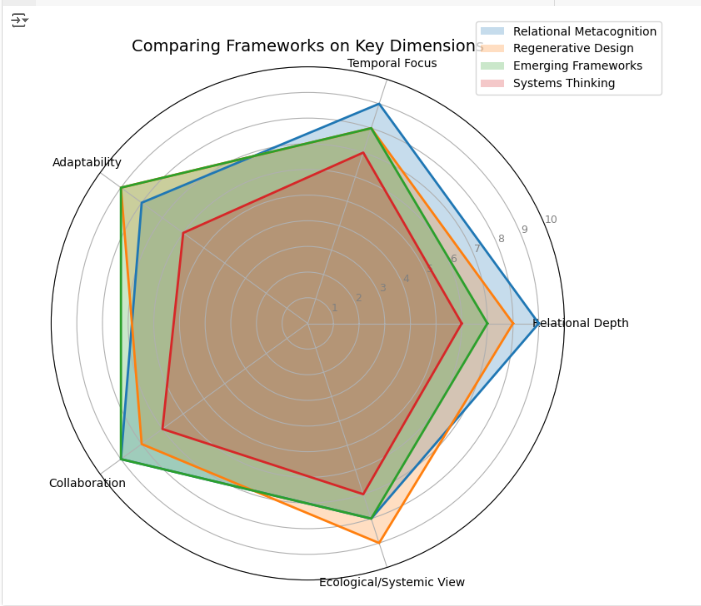
Beyond Constraints
Regenerative and relational approaches view constraints as starting points for negotiation and evolution rather than limitations. This relational understanding amplifies a system’s unique essence while co-creating conditions for its future possibilities.
From Control to Complexity
Conventional systems thinking often seeks to impose control on complexity, viewing relationships as static or goal-driven. All the above authors embrace complexity, acknowledging that systems are emergent and dynamic. Regenerative practices thrive by nurturing conditions for systems to evolve naturally, rather than enforcing rigid outcomes.
Temporal and Contextual Dimensions
Regenerative and relational approaches honor past, present, and future interplay. This deeply grounded perspective recognizes that true potential emerges in the dynamic intersection of relationships, histories, and present dynamics. Relational metacognition amplifies this by encouraging reflection on how relational commitments shape cognition and action over time (past, present, and future).
The Complementary Role of Relational Metacognition in Adaptability
Although RM does not take the lead in adaptability, it plays a crucial complementary role. Its focus on relational reflection and the building of commitments lays the foundational groundwork for resilience, enabling systems to be better prepared to navigate complexity in the long term. By deepening relational understanding and co-creation, RM strengthens the social and cognitive fabric that forms the core of truly adaptive systems.
In essence, RM’s lower adaptability score reflects a deliberate trade-off: a commitment to relational depth and reflective growth over rapid systemic adjustments. Together with more adaptive frameworks like regenerative design or systems thinking, RM can enhance systems’ capacity to evolve, albeit at a slower and more deliberate pace.
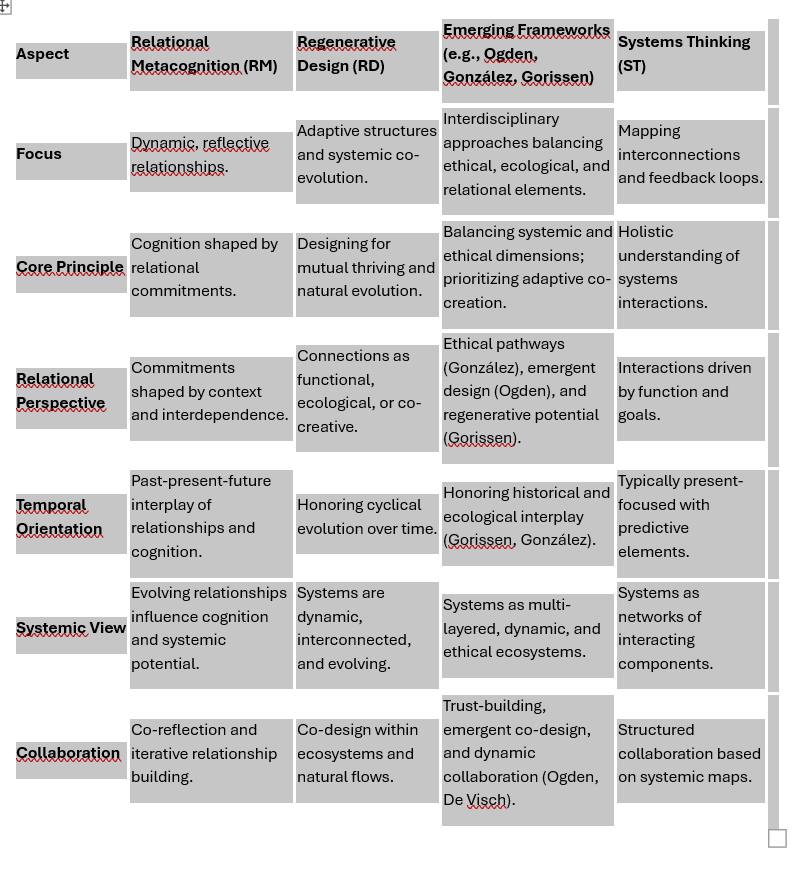
Expanded Table: Comparing Relational Metacognition, Regenerative Design, Systems Thinking, and Emerging Frameworks
Wrap up
Beyond Static Systems Thinking
While traditional systems thinking provides foundational tools to analyze interconnections, it often remains constrained by its focus on transactional relationships and goal-oriented designs. Contemporary thinkers like Ogden and González push these boundaries by incorporating ethics, adaptability, and trust-building into their frameworks. Their approaches resonate with relational metacognition’s focus on emergent relationships but place more emphasis on moral dimensions and collective sense-making.
Ecosystem-Inspired Insights
Leen Gorissen’s regenerative design framework brings an ecosystem perspective, seeing constraints not as barriers but as opportunities for growth and evolution. This aligns well with RM’s focus on dynamic interplay but broadens it to include ecological systems and their potential to innovate naturally.
Emergence and Evolution
Curtis Ogden’s emphasis on emergent design and energy flows reflects a systems view that prioritizes the unfolding nature of relationships. His contributions align with regenerative design in fostering conditions for systems to heal and evolve, while RM adds the meta-cognitive dimension to reflect on the how and why of these dynamics.
Ethical Dimensions
Jesús Martín González’s MAMA framework highlights the ethical and moral imperatives of systems work. This brings a normative lens often absent in traditional systems thinking but complements relational metacognition and regenerative design by anchoring them in shared human values.
Visualization and Practice
Miguel Pantaleón offers practical tools like causal loop diagrams that help visualize complex systems but focuses less on relational or cognitive depth. His contributions make him a bridge between traditional systems thinking and frameworks emphasizing adaptive mapping, such as De Visch’s Dynamic Collaboration.
Conclusion
Relational metacognition complements regenerative and systemic approaches by adding a meta-reflective layer that examines how relationships actively shape and adapt cognition. Thinkers like Gorissen, De Visch, Pantaleón, González, and Ogden contribute essential tools for navigating complexity, focusing on structures, ecosystems, and collaborative networks. Together, these frameworks highlight the potential to move beyond static systems into relationally regenerative paradigms that honor the emergent, dynamic nature of human and ecological systems.
Thank you: Leen Gorissen, Jesús Martín González, Curtis Ogden, Miguel Pantaleon, Jan de Visch for all your insights and your feedback on this article!
 Innovation OIC
Plaats een reactie